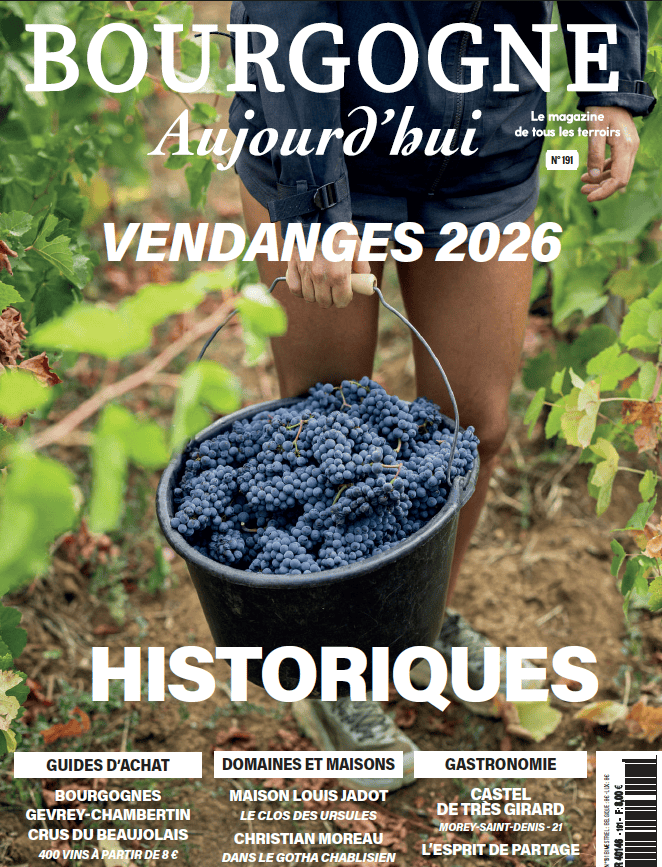
In this issue ( number 175) of Bourgogne Aujourd'hui : the wines of the Mâconnais region, the Colline des Cortons, the domaine Jean-Claude Bachelet, the editorial team's "favorite," a feature on the local produce of Clos of Vougeot , Stéphane Derbord's tips for making a good pot-au-feu and an interview with Saskia de Rothschild, the new owner of the domaine William Fèvre , at Chablis and Didier Séguier, the stage manager.
Below are some excerpts from this interview between the two of them, the full version of which can be read in Bourgogne Aujourd’hui.
Why did you want to establish yourselves in Burgundy and in Chablis ?
Saskia de Rothschild: What's wonderful about William Fèvre is that it's a 70-hectare vineyard that's already very well-established and diversified. Its size offers many possibilities, with, as we strongly believe at DBR Lafite, the ability to produce exceptional wines for special occasions and more accessible wines for everyday enjoyment, offered by the glass in restaurants, etc. We have, of course, Lafite Rothschild, L'Évangile, but also, in the Entre-deux-Mers region, a fifty-hectare estate, Château Paradis Casseuil, where they produce an excellent organic Bordeaux for under €20, or even in the Corbières, the Château d'Aussières. We believe it's healthy to have a very diverse offering. It helps keep us grounded.
Examples of successful Bordeaux winegrowers establishing themselves in Burgundy vineyards, and vice versa, are rare, and more generally, few connections exist between Burgundians and Bordelais. How do you explain this? Is it due to geographical or cultural distance?
SDR: I was fortunate enough to spend time in Burgundy, meeting winemakers and being invited to the Henri Jayer meetings. I listened and learned a great deal, particularly about how Burgundians use oak barrels, which we are trying to implement for our reds. We will learn and see what we can contribute, especially regarding our efforts to adapt to climate change, plant material, and organic practices, which are well established at William Fèvre and which we have been practicing at L'Évangile since 2011. William Fèvre has a well-established team that knows this terroir. Chablis I don't want to revolutionize anything, and it should all work out fine. I'm not worried.
Didier Séguier, you had a foothold in Chablis since your arrival here in 1998 and the other in Côte-d'Or, due to the links between William Fèvre and Bouchard Père & Fils. Do you think it remains to Chablis a "pioneering" spirit?
There's a great open-mindedness here. It's a vineyard with 2,000 years of history, but also, in some ways, very "young," focused on innovation, with a strong environmental orientation among the younger generation. And then Chablis is halfway between Burgundy and Champagne, which has a clear influence on the modernity that one feels in Chablis .
Can we speak of a vineyard that is both historical and pragmatic?
DS: Exactly, people remain farmers, keep their feet on the ground, still go to the vineyards, and technology doesn't scare them. They move forward, they're not afraid of change, which is perhaps less the case in the Côte-d'Or. It's important to remember that William Fèvre was a visionary, designing very modern facilities here more than fifty years ago, incorporating gravity-flow winemaking, water recycling from tank runoff, and so on. You had to think of that in 1972!
The size of the Domaine William Fèvre obviously can't intimidate a Bordeaux native, but with 70 hectares of vines spread across 130 plots, you're going to produce a lot of different wines, all 100% white. This mosaic, this new world of Burgundy's climats, this close link between places and wines—does it fascinate you, frighten you, or motivate you?
SDR: But it's this identity that I fell in love with above all! I learned about this world as a taster and, to some extent, as a winemaker. At Lafite, the 100 hectares are divided into 50 parcels that we know intimately. They are monitored throughout the year, vinified separately, and blended by asking ourselves what each one will contribute. I already have some knowledge of the place, but I arrive here with many questions, curiosity, and a desire to understand why we obtain such different wines. In my generation and the next, there's a demand for sincerity and authenticity, and what clearer, purer message could there be than to say: this parcel produced this wine! The element of rarity is also very important. More and more, we need to produce wines that embody character, that tell stories, and each of these climats tells a different story. People want to know what's behind the label, what the soul and history of this wine are. That's what fascinates consumers.
How does one find their way through such a mosaic?
DS: Through highly precise monitoring of each of the 130 plots of domaine Essential work on grape ripeness, which can change very quickly with warming temperatures, an accumulation of details… In twenty-five years, consumer expectations have completely changed. We have gone from “mass” consumption to a genuine expectation of authenticity and precision, to which Burgundy, though not alone, responds perfectly. As early as 1998, we embraced this approach by isolating plots, which until then had been blended, to create separate cuvées: the grand cru Côte Bouguerots (in Les Bougros), the premier crus Les Lys (in Les Vaillons), Les Vaulorents (in Les Fourchaumes), etc.
Have you also changed many things in vinification And in livestock farming?
DS: We quickly moved away from new oak barrels, which tended to dominate the wines and ultimately neutralize the expression of the terroir. Today, the work of vinification The aging process, whether in barrels and/or tanks of varying sizes, is a meticulous, bespoke process, tailored to each plot and vintage. Our style is to strive, by all means, to highlight the unique character of each wine. SDR: In all our vineyards, we believe the cellar is merely a stage in revealing what the terroir has to say. We are very hands-off, and what greatly appealed to us here, even impressed us, is seeing how the vineyard is conceived, managed, monitored, and prioritized. This is the key to William Fèvre's approach.
HAS Chablis There's a lot of talk, a whole lot, about "minerality," sometimes using a "local" tasting vocabulary. I'm thinking of "shelly" aromas, which refer to notes of iodine, oyster shells. Do you already speak Chablis?
SDR: The words used to describe wine are extremely important, and we professionals still have a lot of work to do to describe our wines in a way that is approachable and understandable to everyone. Furthermore, I find that this notion of minerality resonates because it's visual and sensory. I can picture myself licking a pebble. This matters, and it's undoubtedly why there's so much enthusiasm and debate surrounding minerality. Minerality is also a very broad concept, ranging from chalk and iodine to the pebbles on Breton or Norman beaches, to smokiness. Everyone has their own perception, but it's a reality, of course. DS: The term is sometimes overused, but while there are indeed mineral vineyards, Chablis This is part of it because the Kimmeridgian terroir is unique. It imparts mineral sensations to the wines, and our goal is to transcend all of that. Chablis we don't drink chardonnay We drink Kimmeridgian wine. The wines have a saline, mouthwatering quality, thirst-quenching in the truest sense of the word, that you don't find anywhere else. One glass leads to another, and you finish the bottle. We're here to make wines that are meant to be drunk, not competition wines! SDR: In Bordeaux, we experienced the era of "Parker" wines, very "wow!" They were competition-worthy, oaky Bordeaux, and we've always fought to ensure that our wines continue to be drinkable, balanced, and refined, far beyond mere power.
Let's talk a little about the "organic" topic that seems to be close to both of your hearts. When did this approach begin for William Fèvre?
DS: I arrived in September 1998 and everything had been weeded, even the embankments. I was shocked to see the state the vineyard was in, and not just in Chablis Moreover, I introduced the first cover crops in the spring of 1999, on two hectares, and from the early 2000s, we gradually stopped using herbicides and chemical products to switch to organic farming on almost all of the land. domaine in 2006, without certification at the beginning. The first trials in biodynamics began in 2010 on all the vineyards.
A young woman, who is launching organic wines in historic châteaux, Lafite Rothschild, L'Évangile, "totems" of Bordeaux, French and global viticulture, in a region where the hot and humid oceanic climate complicates things… Has it turned out to be more complicated than you thought?
SDR: It's like anything else, you have to take the time to do things right, to explain that it's a holistic approach to the vineyard. You have to be in the vineyard, observe it, take care of it to ensure its long-term health, and among the various things to do, organic farming is one criterion. Being certified organic, eliminating chemical products, is part of the answer. Many other parameters must be taken into account: the balance with biodiversity, the precision of the vineyard work… So the certification process began at L'Évangile in Pomerol in 2017, and in 2018, we were devastated by downy mildew due to an under-dosage of copper in the initial treatments. It was a valuable lesson! We reflected, worked differently, continued to move forward, and the process was also launched at Lafite, but in a more gradual and reasoned way, in stages: twenty hectares, then thirty, forty… You don't convert 100 hectares all at once. In 2021, I realized the team was ready, and we began the certification process across the entire estate. All our French properties will be certified by the 2024 harvest.
Interview by Christophe TupinierPhotographs: Thierry Gaudillère.
Key figures forthe Baron de Rothschild Lafite estates
Château Lafite Rothschild (Pauillac), first grand cru classified: 100 hectares (ha). Château Duhart-Milon (Pauillac), fourth grand cru classified: 70 ha. Château The Gospel (Pomerol): 22 hectares. Château Rieussec (Fargues), first grand cru Classified Sauternes: 80 ha. Château Paradis Casseuil (Entre-deux-Mers- AOC Bordeaux): 50 ha. Château d'Aussières (Corbières): 170 ha. Properties in Chile, Argentina and China. 1868: Baron James de Rothschild acquires the Château Lafite in Pauillac, and thus begins the winemaking history of the French branch of the Rothschilds. 1945: Baron Elie becomes manager of Château Lafite after the domaine It was seized by Vichy as "Jewish property" to house German officers throughout World War II. He began a major restoration of the vineyard. 1975: Eric de Rothschild succeeded his uncle Elie as manager of the Château in a difficult economic era. He developed modern viticulture, cellar work with Emile Peynaud, and the wine's global reach. Under his leadership, the family's winemaking activity expanded beyond Pauillac, notably into Pomerol with Château The Gospel, in Sauternes with Rieussec and abroad. 2016: Saskia de Rothschild joins her father Eric in managing Château Lafite. She completed a two-year vocational diploma in viticulture and oenology that same year. (Her previous studies had taken her to preparatory classes for the French competitive entrance exams to the Grandes Écoles, HEC Paris, and Columbia University before she embarked on a career in journalism, notably at the New York Times, as a correspondent in France and Ivory Coast. In 2016, she moved from Abidjan to Pauillac.) She is convinced that her era will be one of protection. 2021: Saskia becomes executive manager of Lafite and Domaines Barons de Rothschild Lafite. All of DBR Lafite's French estates will be certified organic by the 2024 harvest. 2024: The family acquires the Domaine William Fevre to Chablis , seduced by its extraordinary and distinctive terroirs, the team's environmental approach and vine culture, as well as the magic of the wines.
William Fèvre 1619 : Jean Fèvre, vigneron à Fontenay-près-Chablis. 1959 : Première déclaration de récolte de William Fèvre, 12<E>e<E> génération, qui reprend le flambeau derrière son père Maurice. Sept hectares (ha) en production. 1960-1970 : Acquisition et replantation de nombreuses parcelles dans les grands crus et premiers crus. 1998 : Rachat par Joseph Henriot, arrivée de Didier Séguier à la tête du Domaine. 48 ha dont 15,20 de grands crus, 16 de premiers crus et 16 de Chablis. 2000-2010 : Conversion progressive du domaine aux pratiques biologiques. 2009-2014 : Certifications environnementales (agriculture raisonnée, HVE 2 et 3). 2010-2020 : Développement des pratiques biodynamiques sur l’ensemble des grands crus et premiers crus. 2023 : Certification bio du domaine. 2024 : Acquisition par DBR Lafite. 70 hectares dont 38 de Chablis, 16 classés en premiers crus et 15,2 en grands crus. L’activité de négoce-éleveur représente un gros tiers de la production totale à 100 % en vins blancs.