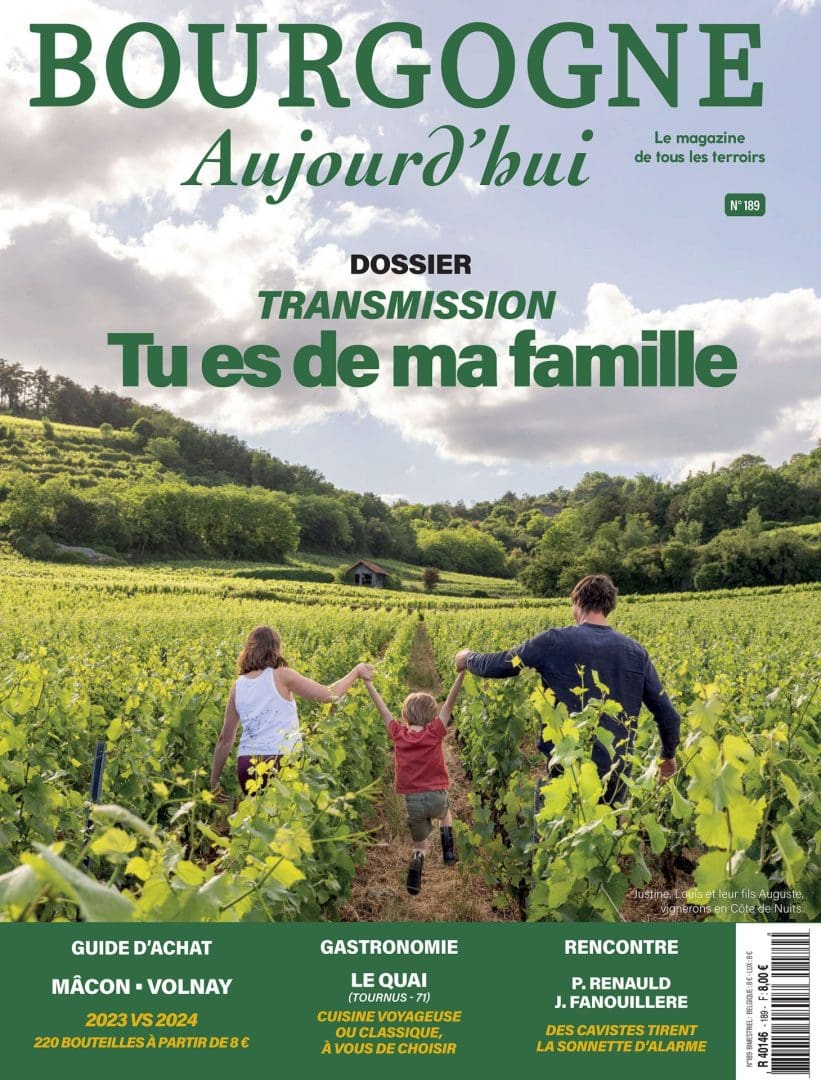
Year after year, organic viticulture is gaining ground in Burgundy and across all wine regions. In its issue 163, Bourgogne Aujourd'hui interviewed Agnès Boisson and Elise Rivière; viticulture consultants for the Bio Bourgogne association, they work daily with estates that are certified organic or in the process of converting to organic farming.
Below are some excerpts from their interview, the full version of which is available in Bourgogne Aujourd'hui.
To begin, tell us about Bio Bourgogne. How long has the association existed?
EliseRivière : The association was created in the 1980s. Its main mission is to develop and promote organic farming with producers, local authorities, schools, and so on. It is made up of people responsible for monitoring and developing the region, and others responsible for providing technical support, like Agnès and myself. All agricultural sectors are represented: market gardening, livestock farming, arable farming, and viticulture.
Agnès Boisson : Our technicians are 100% organic, which sets us apart from other organizations like the Chambers of Agriculture. We only work with organically farmed plots. Winegrowers who want to convert their farms can do it themselves, but that's a shame. Our conversion support services are free because they are funded by the Regional Council.
Is there a typical profile of domaine Who is starting an organic certification process?
ER: Conversion dynamics are really different depending on the department. In Côte-d'Or, the farm typology is smaller, whereas in the Yonne These are larger companies.
AB: To return to the Côte-d'Or, I meet either estates of around ten hectares or very large operations, with over 100 hectares, which was the case in 2021. The approaches, expectations, and resources are completely different. I am also temporarily supporting a few estates in Saône-et-Loire where, again, the concerns are different, as are the climatic conditions.
Let's get down to brass tacks with the latest figures we have. 5,668 hectares were cultivated organically in 2020, representing 17% of the vineyard area. Is this figure on the rise in 2021?
ER: Indeed, the increase continues, as it has for the past three years, primarily in the Côte-d'Or, despite the challenging vintage. The overall trend is still upward. The figure is not yet final, but it should be around 7,000 hectares for all of Burgundy.
How can we explain this constant increase in conversions? What motivates the sectors that are taking the plunge?
ER: Health and environmental protection are two major concerns, with a growing awareness of the future, reflection, and questioning of existing practices. Demand is also increasingly important from an economic point of view, with a expanding market for organic wines.
AB: The government's objective is to guide people towards certifications, not just organic, but we can also talk about the High Environmental Value (HVE) label. Some farms that have been HVE certified for a number of years want to go further and complete the process with organic certification. These two certifications shouldn't be seen as opposing forces; they are complementary. In fact, some organic farms are also obtaining HVE certification. I also meet farms that choose certification with a view to passing the tradition on to future generations. The children will take over the farm. domaine So they want to add value by having a tool that's already AB certified. In Côte-d'Or, I also see farms that have been practicing organic farming for sometimes more than ten years, and who didn't see the point in getting certified. But after talking to their customers who ask them why they don't go for certification, they're finally doing it. Consumer pressure is real.
Is Burgundy considered a model student in the context of French viticulture?
AB: The last figure I have in mind is 14% of vineyards in France cultivated organically. We were already above that in 2020 with 17% in Burgundy. For 2021, we'll be very close to 20%, so Burgundy is indeed above the national average.
We've heard winegrowers complain about the rigidity of the specifications, particularly after the 2016 hailstorm when some organic growers had to resort to conventional treatments in the hope of salvaging what remained of their harvest. They would have liked an exception, governed by specific rules, allowing them to retain their certification and avoid starting the conversion process from scratch. Is such a change conceivable?
AB: The regulations will not change. Every year, there are periods of turbulence, some longer, some shorter, some more significant, or some riskier. The specifications are designed for the consumer, to provide them with the best possible clarity and traceability to guarantee a quality product. Being organic is not a dead end. It is indeed possible to stop and quickly re-engage with your plots. The vast majority of estates that used a synthetic product did so before the 2016 harvest. They were back in organic farming in 2019. To my knowledge, only two did not re-engage quickly. One re-engaged in 2021, and the other did not reapply for certification but continues to apply the same practices.
Interview by Élisabeth Ponavoy. Photographs: Elise Rivière and Agnès Boisson, viticulture consultants for the Bio Bourgogne association. Thierry Gaudillère
The inexorable growth of organically farmed land is confirmed in Burgundy, regardless of whether the vintage is dry or wet. We met with two technicians who work in the field with certified organic estates or those in conversion: Agnès Boisson and Elise Rivière.