The Burgundy Wine Trade Association facing the challenges of tomorrow
by
Morgane AIGU
THE
Despite an increase in Burgundy wine export sales (+7.1% in volume) in the first 5 months of 2025, the Burgundy Wine Board BIVB plays the anticipation card and unveils a series of strategic reforms.
On the right, Laurent Delaunay (president of the BIVB for trade) and François Labet (co-president of BIVB ) which present the presidents' moral report.
This Wednesday, July 2nd, at the Palais des Congrès, Beaune The annual general meeting of BIVB From the very start of the session, the tone was set: international challenges weigh heavily on the shoulders of the wine industry. Gabriel Picard (FEVS: Federation of Exporters of Wines & Spirits of France) spoke frankly about the geopolitical uncertainties that are disrupting the trade balance of Burgundy wines, particularly with the United States.
Faced with this uncertain global context, the BIVB seeks to respond, and this General Assembly was thus the scene of several announcements aimed at addressing international challenges, accelerating the ecological transition, and reaching new audiences. "The period 2026-2036 will indeed be one of transition that we can reflect on, anticipate, and co-create," according to François Labet, co-president. The first symbol of this change: the BIVB becomes "Comité Bourgogne", a more readable and international name.
Reintegration of the City of Climates
Taking over the Cité des Climats et des Vins de Bourgogne is another key element in the interprofessional organization's strategy. The opening of the cities to Beaune , Chablis While Mâcon was certainly praised, several mistakes were acknowledged, notably the lack of synergies with the BIVB “We undoubtedly made organizational errors in the rollout of the Cité des Vins, believing that its quality and successful opening would be enough for immediate success and that the reputation of Burgundy wines would do the rest,” admits François Labet. This has not been the case, and the Committee therefore wishes to integrate the Cité into the industry's overall communication strategy. The Wine School, housed within the Cité des Vins since its opening and long underutilized, is also undergoing repositioning, with the aim of international development.
On the right, Jean-Philippe Gervais (director of the technical and innovation division) and Frédéric Barnier (vice-president) and their AI-generated image representing the Burgundy vineyard in 2050.
"Change everything so that nothing changes"
On the technical and innovation front, the cluster's president, Jean-Philippe Gervais, didn't mince words: "We must allow ourselves to change everything so that nothing changes." He called for a bold overhaul of practices. This notably involves adapting to climate change and developing initiatives like Qanopee and CepInnov . Carbon neutrality by 2035 also remains a goal.
To illustrate his point, he displayed an image created by artificial intelligence, which he had asked to imagine Burgundy in 2050 on the theme of biodiversity. The image spoke volumes: the setting evoked Tuscany more than the current landscapes of our region. "The idea is obviously to project ourselves into the future, to be imaginative, creative, and to leave no stone unturned." This year, one of the actions included in the budget involves working on the development of indicators to characterize biodiversity: "Characterizing a plant is fairly easy, but stating that this plant is in a plot of land, that this plot is part of a landscape, and that this landscape is part of a territory, is already a bit more complicated." He mentions a lack of knowledge about biodiversity indicators, which would make it possible to establish a state of affairs, to know where Burgundy stands, how it is evolving and, in the future, to identify the most adapted “individuals” (plant material).




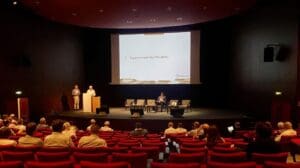 On the right, Laurent Delaunay (president of the BIVB for trade) and François Labet (co-president of BIVB ) which present the presidents' moral report.
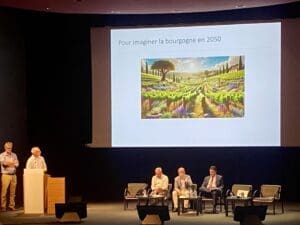 On the right, Jean-Philippe Gervais (director of the technical and innovation division) and Frédéric Barnier (vice-president) and their AI-generated image representing the Burgundy vineyard in 2050.