
Wine Tourism Rendezvous
Le gamay à l’assaut de la Gen Z
La première édition des Gamays Days s’est tenue durant le week-end de Pentecôte à Confluence (Lyon), dans une ambiance chill.

L’Écume Gourmande à Cercié

GOOD AND GOOD FOR YOUR HEALTH
BUYING GUIDE
CASE
GASTRONOMY
Rémi Genot - By the Bell Tower


In any vintage, the final stretch is crucial, and in 2025, it holds some tricky challenges for producers in the form of very unsettled weather. This is all the more frustrating given that the year was generally sunny and relatively calm, with the notable exception of hail storms and heavy mildew pressure in the southern Mâconnais and northern Beaujolais regions.
Without going into the details of the 2025 climatic season, let's take a look back at the long heatwave that lasted almost two weeks, from August 7-8 to August 19, during which temperatures regularly reached or even exceeded 35 degrees in the shade, peaking just before August 15, when they even passed the 40°C mark. In these extreme conditions, natural degrees climbed by concentration, through evaporation of water, while the classic process of ripening by photosynthesis was blocked, particularly in Pinot Noir, but also in Chardonnay.
"For me, it's not ready yet."
We know that the question of ripeness is always a very sensitive subject in Burgundy, and what ripeness are we talking about? Sugar levels? On this point, good levels have been reached just about everywhere, but when it comes to phenolic ripeness, the ripeness of skins and aromas, essential in pinot noir as in chardonnay, it's a different story. Some of the winegrowers contacted since the beggening of the week even feel that the situation is not satisfactory, and will not be harvesting before the end of this week, or even next week. "The soils are dry and capable of withstanding 50 mm of rain. The vines are thirsty, the grapes have thick skins and they're not going to rot in the blink of an eye", says Vincent Dureuil, winemaker at Rully (Côte Chalonnaise), who will start picking early next week. "There are already 13 natural degrees, but when I taste the Chardonnays, they're simply not ripe. They lack juice, the pulp is gelatinous and I don't know how to make good wines in these conditions. We're not going to start until Friday August 29 at the earliest," adds Vivien Saumaize (domaine Saumaize-Michelin), winemaker at Vergisson (71), in the Pouilly-Fuissé cru, where patience seems to be the rule.
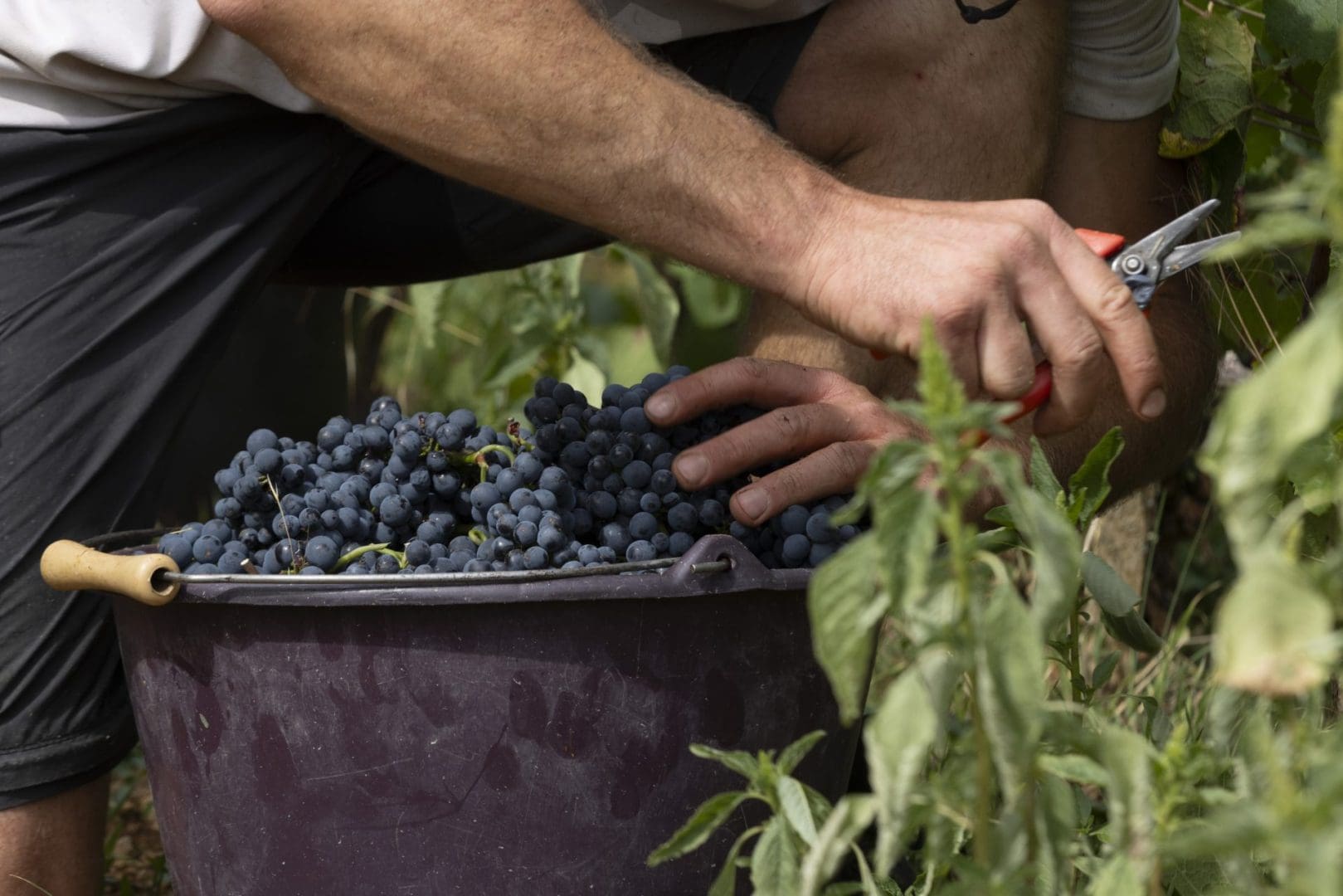
Grape harvest in the hills of Beaune (photo Bénédicte Manière).
Let's add the style each winemaker is looking for. "Burgundy's reputation was built on balanced, elegant wines with substance and body. For me, it's not quite ready yet, even though there's superb potential to be unlocked in 2025. It's the end of August, not the end of September! There's no rush! The grapes are healthy, without a trace of rot, so I'm not going to ruin a year's work in the vineyards by harvesting a week too early," concludes Thomas. Bouley , winemaker at Volnay , which will therefore begin harvesting in the middle of next week, on September 3rd.
It's difficult to get a clear picture, especially considering that harvesting 5 hectares is approached differently than harvesting 60, and that terroir, vine age, pruning dates, and more broadly, agronomic practices, planting densities, yields… are all factors that influence the ripening process. Nevertheless, the first grape pickers appeared in the vineyards at the beginning of last week, around August 18th or 19th. Meursault Puligny-Montrachet (photo below in the premier cru The Maidens) and Chassagne-Montrachet and the chardonnay which withstood the heat a little better than the pinot noir , was harvested first. The first grape pickers… and you understood that in the same villages The last ones will still be walking their buckets through the rows at the end of next week, or even the beginning of the following week. August 18th, September 11th-12th, quite a gap, and we can therefore logically expect to have two vintages in one in 2025 with wines made from grapes harvested before the rains and those made after.
A little water…
Let's conclude with a piece of information that probably says a lot about the effects of global warming and climate change on plants. While a few showers (5 to 20 mm) timidly sprinkled Côte-d'Or and Saône-et-Loire on August 20 and 21, around 70 mm fell in Yonne. A very heavy downpour which, in theory, should have resulted in dilution in the berries and at least a temporary drop in degrees, but the opposite happened... Twice-weekly ripeness samplings carried out by the BIVB on reference plots throughout Burgundy show that between August 21 and 25, sugar levels soared in Yonne (+15 grams of sugar in Chardonnay and +13 in Pinot Noir), close to a potential natural degree, while they progressed much more "sluggishly" in other wine-growing regions.
“We were all surprised. The vines were thirsty. The water has clearly restarted photosynthesis, released the sugars, brought juice to the berries, while also creating a few small pockets of rot. Overall, it's positive, but we need to keep going,” explains Benoît Droin , winemaker at Chablis harvesting finally began on the morning of August 27th. Will the 20, 30, 40 mm of rain forecast for the coming days also have the effect of "unlocking" phenolic ripeness in the numerous plots still to be harvested throughout Burgundy? That's certainly what we can hope for the producers who have chosen to wait to capture the very essence of this 2025 vintage, which is far from having revealed its full potential!
Photographs: Bénédicte Manière (homepage photos and basket of grapes) pinot noir )

Tastings
Il faut se méfier des réputations. 2024 a donné des sueurs froides aux producteurs bourguignons et son image ne fait pas saliver les amateurs. Pourtant, ce millésime compliqué se révèle très réussi à Volnay. Une éclatante surprise.

Tastings
If the red wines of Jura While these things might have been amusing fifteen years ago, they are quite different today. Wines have changed considerably due to global warming coupled with a real awakening of awareness among winemakers, and the trousseau deserves to be seen now as a great grape variety rouge .

Tastings
Behind the slightly provocative name of this cuvée produced by Domaine Chasselay, an objective analysis of the situation even allows one to think that the Beaujolais is far from being six feet under and even has many tricks up its sleeve to come out on top in the current wine crisis.


